Siyaka's Vision on the Hilltop — the Crow and the Owl
IHHB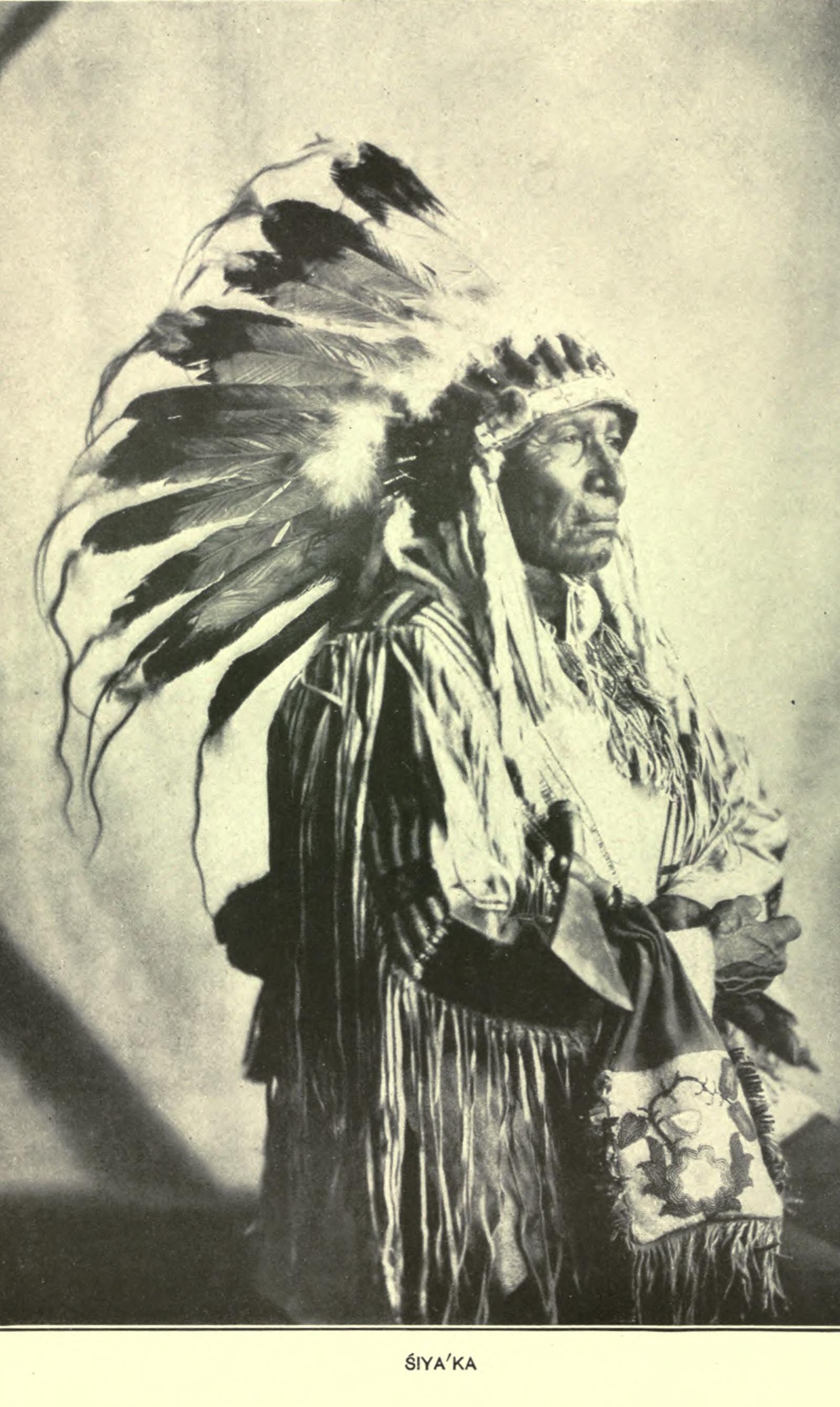
Siyáka (Teal Duck) of Standing Rock was the first Lakota elder whose portrait opens the great 1918 collection of Teton Sioux songs and stories — and one of its most generous tellers. Around 1913 he described how, as a young man, he sought his vision on a hilltop. These are his own words: "All classes of people know that when human power fails they must look to a higher power for the fulfillment of their desires. There are many ways in which the request for help from this higher power can be made. Some like to be quiet, and others want to do everything in public. Some like to go alone, away from the crowd, to meditate upon many things. When a man shuts his eyes, he sees a great deal. He then enters his own mind, and things become clear to him. No man can succeed in life alone, and he can not get the help he wants from men; therefore he seeks help through some bird or animal which Wakan Tanka sends for his assistance. Many animals have ways from which a man can learn a great deal, even from the fact that horses are restless before a storm. "When I was a young man I wanted a dream through which I could know what to depend upon for help. Having this desire, I went to a medicine-man and told him about it. He told me to get four well-tanned robes, with one for my own use, also a decorated pipe and offerings of tobacco. He painted my face white, and before leaving him we went together into the sweat lodge. I had already selected a hill on which to await my dream. "In the middle of this hilltop I dug a hollow about two feet deep, large enough so that I could crouch against its side when weary with standing. At each of the four points of the compass I placed one of the robes and some of the tobacco. These offerings were to show that I desired messages from the directions of the four winds and was waiting anxiously to hear the voice of some bird or animal speaking to me in a dream. "Having placed these offerings in position, I stood facing the west and watched the sun disappear. As soon as the sun was out of sight I closed my eyes and turned my face toward the east, standing thus for awhile, then facing the north and the south. So I stood, wrapped in a buffalo robe. I was not exactly singing, but more nearly lamenting, like a child asking for something. "Beside me, at the north, was placed a buffalo skull, the face of which was painted with blue stripes. The openings of the skull were filled with fresh sage, and it was laid on a bed of sage, facing the south — for when the buffalo come from the north, traveling toward the south, they bring news that Wakan Tanka has provided food for the Indians and there will not be a famine. "As I still faced the west, after the sun had set and when it was almost dark, I heard a sound like the flying of a bird around my head, and I heard a voice saying, 'Young man, you are recognized by Wakan Tanka.' This was all the voice said. "All night I stood with my eyes closed. Just before daybreak I saw a bright light coming toward me from the east. It was a man. His head was tied up, and he held a tomahawk in his hand. He said, 'Follow me,' and in an instant he changed into a crow. In my dream I followed the crow to a village. He entered the largest tent. Opposite the entrance sat a young man, painted red, who welcomed me. He said that all the animals and birds were his friends. He told me to lift my head. I did this and saw dragonflies, butterflies, and all kinds of small insects, while above them flew all kinds of birds. As soon as I cast down my eyes again, I saw that the young man had become transformed into an owl, and that my escort had changed again into a crow." The song given him in this dream: At night may I roam, against the winds may I roam — at night may I roam, when the owl is hooting, may I roam. At dawn may I roam, against the winds may I roam — at dawn may I roam, when the crow is calling, may I roam. Then the owl spoke: "Always look toward the west when you make a petition, and you will have a long life." And when Siyáka looked at him again, the owl had changed into an elk, and at his feet lay the elk medicine and a hoop. From the elk he learned a second song: Where the wind is blowing, the wind is roaring — I stand. Westward the wind is blowing, the wind is roaring — I stand. ——— CREDITS & SOURCE Told by: Siyáka (Teal Duck), Standing Rock Lakota — recorded c. 1913, interpreted by Robert P. Higheagle (Lakota). Published in: Frances Densmore, "Teton Sioux Music," Bureau of American Ethnology Bulletin 61 (Washington: Smithsonian Institution, 1918), pp. 184–188. Public domain (U.S. government publication, pre-1930). Photo: Siyáka, Plate 1 (frontispiece) of the same volume. Shared here in honor of the teller. If this story belongs to your family or community and you would like it presented differently, please reach out.