Old Buffalo's Vigil — a Prayer for His Niece
IHHB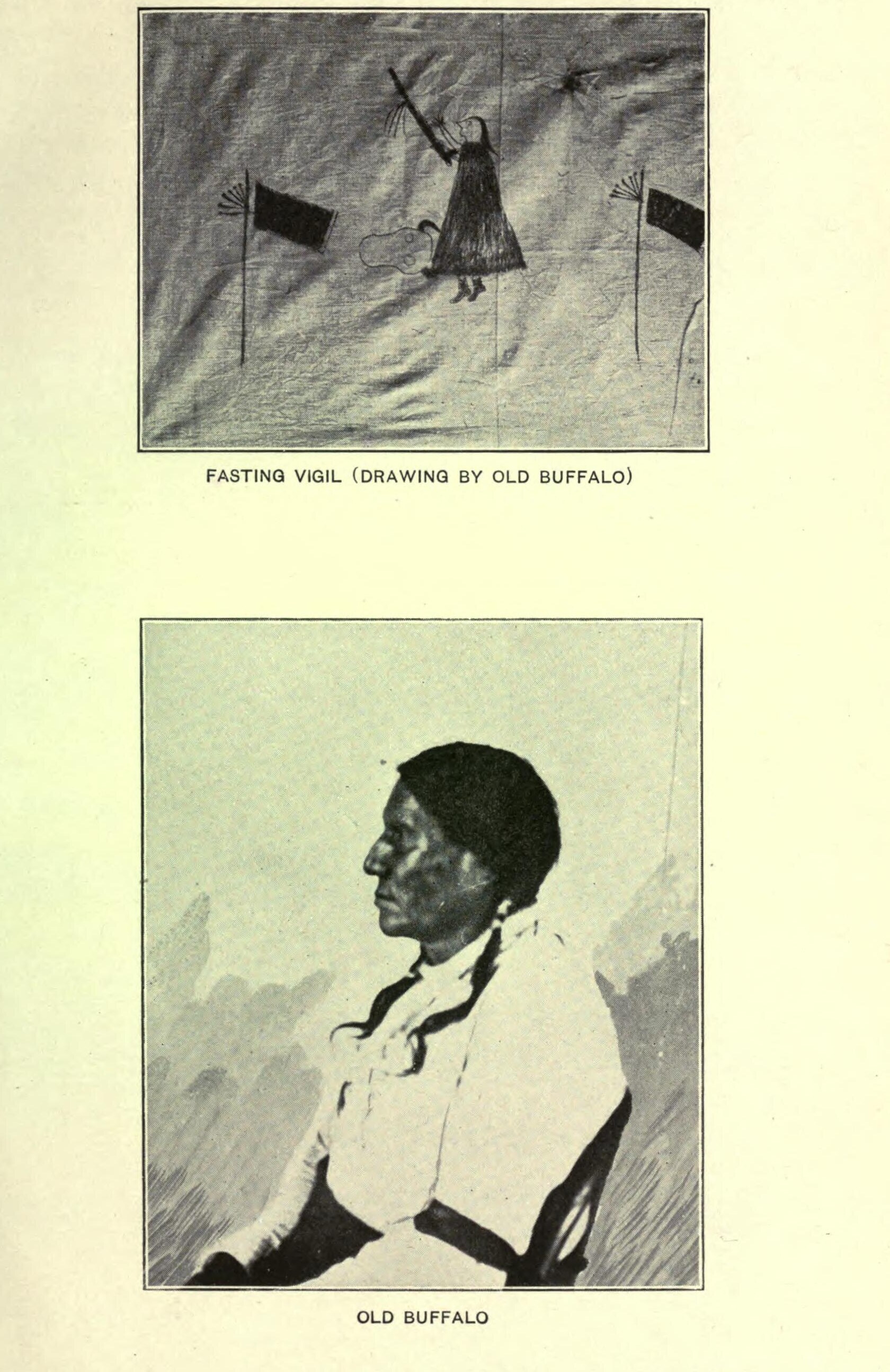
It was with no little hesitation that Old Buffalo (Tataŋk-ehaŋni) of Standing Rock told this story — an account of a prayer vigil he kept for a niece who was very ill, and who, he believed, recovered because of it. He also drew the scene himself; his drawing appears above his portrait in the photo. He told it in the present tense, as if living it again, and it was written down that way around 1913. These are his words: "I have a sister older than myself. We are children of one father and one mother. As my sister's child is growing up to be a young girl, she is taken sick, and is so thin that there is no flesh on her bones. She can not rise from her bed. I sit beside her. She asks me to bring her a drink of water. My heart is very sad. As I see her my thought is, 'I will call on Wakan Tanka for help.' I could not bear the thought of going many miles barefoot, but I wanted the girl to recover. "I go on a high hill and make a vow, saying: 'Wakan Tanka, I call upon you. Have pity on me. My niece is on her deathbed. Have pity on her, so she can live on earth and see you. Give me strength to do what is right and honest. I will give you four sacrifices. I will smoke a fine pipe. It is a Chief pipe, so you can bless it. I will do this in your honor if you will spare her life.' "The girl gets better. She drinks water and eats a little food. "Now I am going to fulfill my vow to Wakan Tanka. It is July, and the weather is very hot. They make a lodge for me at some distance from the village. Several men take the big-leaf sage and spread it on the ground in the lodge, then they bring hot stones and pour water on them. As I sit in the lodge it is filled with steam. When I am wet with perspiration the men rub me with sage. They take a buffalo robe, put it around me with the fur outside, and tie it across my chest. The discomfort of wearing this heavy robe is part of my sacrifice. No moccasins are on my feet. So I start for the distant hill where I am to offer my prayer. I carry a pipe decorated with ribbons and mallard-duck feathers, holding the stem upward in front of me as I walk. The sun has not long risen as I leave the village, and I reach the hill before noon. There I find a buffalo skull, which a man has brought from the village. It is a large skull with horns on it. My friends have also prepared a soft place on the ground for me and covered it with sage leaves, that I may rest when I am too weary from standing. "That afternoon I hold the pipe and follow the sun with it. At night I lie face down on the sage. "Now the sun has risen. I stand up again, facing the east and holding the pipe. All day I follow the sun with the stem of the pipe. The second night I stand up all night, until the daylight appears. Then I put my pipe against the buffalo skull and lie down with my head near it. When the sun is fully risen I stand up again and cry, saying, 'Give me strength for long life, and strength to be right and honest in all I do.' On the third day I put a piece of red cloth at each of the four directions. "Just as the sun is getting low on this day they come for me. I leave the buffalo skull, the pipe, and the four offerings of red cloth on the hill. Now I am going back with my friends, still walking with bare feet. They have made a new sweat lodge near the old one, and I am the first to enter it. Again they bring hot stones and pour water on them, and again they rub me with the sage leaves. After this I put on moccasins and leggings, and go away. "This is the means by which we prolonged our lives in the old days. My niece recovered." When he was asked afterward about the care the girl had received from the doctor, Old Buffalo replied indignantly: "It was Wakan Tanka who saved her life; not the doctor. She lived in answer to my prayer." ——— CREDITS & SOURCE Told by: Old Buffalo (Tataŋk-ehaŋni), Standing Rock Lakota — recorded c. 1913, interpreted by Mrs. James McLaughlin. Published in: Frances Densmore, "Teton Sioux Music," Bureau of American Ethnology Bulletin 61 (Washington: Smithsonian Institution, 1918), pp. 274–275. Public domain (U.S. government publication, pre-1930). Photo: Plate 42 of the same volume — Old Buffalo's own drawing of his fasting vigil, above his portrait. Shared here in honor of the teller. If this story belongs to your family or community and you would like it presented differently, please reach out.