My First Buffalo — Luther Standing Bear's Hunt as a Boy
IHHB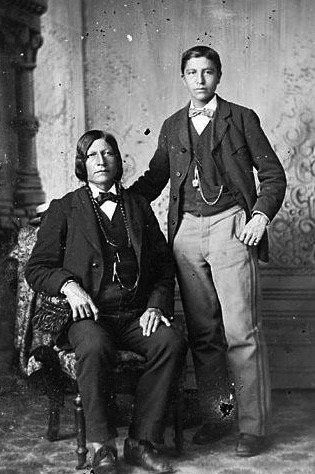
Luther Standing Bear — born Óta Kté ("Plenty Kill"), son of Chief Standing Bear of the Sicangu Lakota — was one of the first Native authors to tell his people's story in his own words. In his 1928 book "My People the Sioux" he remembered his first buffalo hunt as a boy, when his band was camped between the White River and Crow Butte, in northwestern Nebraska. These are his words, lightly condensed: We were hungry for buffalo meat, and we wanted the skins. So one day we left the agency without a permit. We were very independent in those days. We started for the northern part of Nebraska, as we knew that section to be good hunting-grounds. I had been out with my father and grandfather many times on buffalo hunts, but they had always attended to the killing, and I had only assisted in the eating afterward. But this time I was going as a hunter. I was determined to try to kill a buffalo all by myself if possible. My father had made me a special bow and some steel-pointed arrows with which to kill big game, and this was to be my first chance to see what sort of hunter I was. A scout had been sent out, and one morning, very early, he reported that there were some buffalo near. Everybody, including myself, began to get ready. While one of my stepmothers was helping me, she said, "Son, when you kill a buffalo, save me the kidney and the skin." I didn't know whether she was trying to poke fun at me or to give me encouragement. But it made me feel proud to have her talk like that to me. The night before the hunt, my father instructed me: "My son, the land on which these buffalo have been found is reported not to be rough, and you will not have to chase the buffalo into dangerous places, as the land is very level. Whatever you do, watch the buffalo closely. If the one you are after is running straight ahead and not turning, then you can get in very close, and you will stand a good chance to shoot it in the heart. But if you observe the buffalo to be looking at you from the corner of its eye, then look out! They are very quick and powerful. They can get their horns under your horse and toss him high in the air, and you might get killed. Keep your eyes open! In the beginning there will be lots of dust, but after you pass through that, it will be clear, and you will be able to see where you are going." At the top of the hill, all the hunters turned their horses loose, and the animals started in running like the wind! I whipped up my little black mare and nearly got ahead of the others. Soon I was mixed up in the dust and could see nothing ahead of me. All I could hear was the roar and rattle of the hoofs of the buffalo as they thundered along. My pony shied this way and that, and I had to hold on for dear life. My pony ran like the wind, while I just clung to her mane; but presently we came out of the dust. I was quite a bit ahead of the buffalo now, and when they caught sight of me, they started running in two different directions. When I looked at those big animals and thought of trying to kill one of them, I realized how small I was. Then I thought about what my stepmother had said to me about bringing her a kidney and a skin, and the feeling that I was a man, after all, came back to me; so I turned my pony toward the bunch which was running north. I pulled out one of my arrows and shot into the middle of them. I did not even know where my arrow went, and was just thinking of quitting when I observed a young heifer running slower than the others. I made up my mind I was going to kill that buffalo if it took all the arrows in my quiver. I rode right up alongside the buffalo, just as my father had instructed me. Drawing an arrow from my quiver, and holding to my pony with all the strength of my legs, I fitted the arrow and let drive with all my strength. The arrow went into the neck — and I thought I had taken such good aim! But the buffalo only shook her head and kept on running. I again caught up with her, and let another arrow loose, which struck near the heart. Then I pulled my third arrow and fired again. This went into the heart. I began to think that buffalo had all the nine lives of a cat. I shot my fourth arrow into her, and she staggered and dropped over on her side, and was soon dead. So I had killed my first buffalo. When I examined the fallen animal and noted that I had shot five arrows into her, I felt that this was too many arrows for just one buffalo. Then I recalled that my father had once killed two buffalo with only a single arrow. I began to think of pulling all the arrows out but one. In fact, I had started to do this, when a remark that my father had once made to me came into my head. It was, "Son, always remember that a man who tells lies is never liked by anybody." So, instead of trying to cheat, I told the truth; and it made me feel happier. My father was so pleased that I had tried to do my best. I told him about the number of arrows I had had to use, and where each one had struck. He laughed, but he was proud of me. I guess it was because I had told the truth, and not tried to cheat or lie, even though I was just a youngster. When we reached home it made me very proud to be able to give my stepmother the skin and kidney. My father called the old man of the camp, who always acted as herald, to announce that Óta Kté (or "Plenty Kill") had shot his first buffalo, and that Standing Bear, his father, was giving away a horse. This was the first and last buffalo I ever killed, and it took five arrows to complete the job. ——— CREDITS & SOURCE Written and told by: Chief Luther Standing Bear (Óta Kté / "Plenty Kill"), Sicangu and Oglala Lakota (1868–1939). From: "My People the Sioux" (Boston: Houghton Mifflin, 1928), chapter 5, "My First Buffalo." Public domain in the United States (published before 1930). Read the original: https://archive.org/details/my-people-the-sioux Photo: young Luther Standing Bear with his father, Chief Standing Bear, c. 1880 (public domain, via Wikimedia Commons). Shared here in honor of the teller. If this story belongs to your family or community and you would like it presented differently, please reach out.