First Days at Carlisle — Luther Standing Bear Chooses a Name
IHHB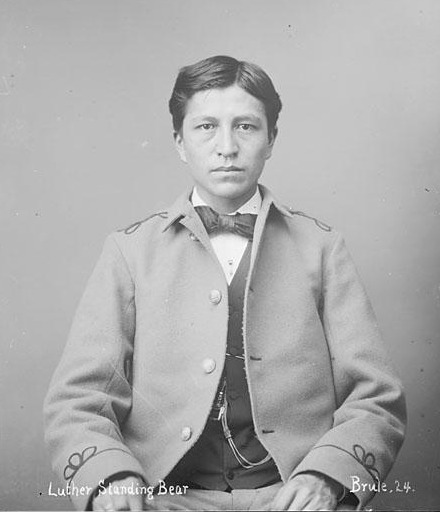
In October 1879, a trainload of Lakota children arrived in Pennsylvania to become the first class of the Carlisle Indian Industrial School. Óta Kté — Plenty Kill, son of Chief Standing Bear — was the first child through the gate. Fifty years later he wrote down what those first days were like. These are his words, lightly condensed: "At last the train arrived at a junction where we were told we were at the end of our journey. Here we left the train and walked about two miles to the Carlisle Barracks. Soon we came to a big gate in a great high wall. The gate was locked, but after quite a long wait, it was unlocked and we marched in through it. I was the first boy inside. At that time I thought nothing of it, but now I realize that I was the first Indian boy to step inside the Carlisle Indian School grounds. "The first room we entered was empty. We ran through all the rooms, but they were all the same — no fire, no beds. We took off our leggins and rolled them up for a pillow. All the covering we had was the blanket which each had brought. We went to sleep on the hard floor, and it was so cold! How lonesome the big boys and girls were for their far-away Dakota homes where there was plenty to eat! The big boys would sing brave songs, and that would start the girls to crying. "I had come to this school merely to show my people that I was brave enough to leave the reservation and go East, not knowing what it meant and not caring. "One day when we came to school there was a lot of writing on one of the blackboards. Our interpreter came into the room and said, 'Do you see all these marks on the blackboard? Well, each word is a white man's name. They are going to give each one of you one of these names by which you will hereafter be known.' The teacher handed a long pointed stick to the first boy and told him to pick out any name he wanted. The boy turned to us as much as to say, 'Shall I — or will you help me — to take one of these names? Is it right for me to take a white man's name?' Finally he pointed out one of the names. The teacher wrote it on a piece of white tape and sewed it on the back of the boy's shirt. "When my turn came, I took the pointer and acted as if I were about to touch an enemy. I had selected the name 'Luther.' When the teacher called the roll, no one answered his name. She would walk around and look at the back of the boys' shirts, and when she had the right name located, she made the boy stand up and say 'Present.' I was one of the 'bright fellows' to learn my name quickly — how proud I was to answer when the teacher called the roll! The first few times I wrote my new name, it was scratched so deeply into the slate that I was never able to erase it. "How lonesome I felt for my father and mother! Right then and there I learned that no matter how humble your home is, it is yet home. "One day we had a strange experience. We were all called together by the interpreter and told that we were to have our hair cut off. That evening the big boys held a council, and I recall very distinctly that Nakpa Kesela, or Robert American Horse, made a serious speech. Said he, 'If I am to learn the ways of the white people, I can do it just as well with my hair on.' To this we all exclaimed 'Hau!' — meaning that we agreed with him. "In spite of this meeting, a few days later we saw some white men come inside the school grounds carrying big chairs. One of the big boys named Ya Slo, or Whistler, was missing. In a short time he came in with his hair cut off. In this way we were called out one by one. When my hair was cut short, it hurt my feelings to such an extent that the tears came into my eyes. "All his instructions to me had been along this line: 'Son, be brave and get killed.' This expression had been moulded into my brain to such an extent that I knew nothing else. Now, after having had my hair cut, a new thought came into my head. I felt that I was no more Indian, but would be an imitation of a white man." Luther Standing Bear survived Carlisle, and he spent his life proving that thought wrong — becoming a chief, an author, and one of the fiercest defenders of Lakota identity ever to hold a pen. ——— CREDITS & SOURCE Written and told by: Chief Luther Standing Bear (Óta Kté / "Plenty Kill"), Sicangu and Oglala Lakota (1868–1939), first student through the gate at Carlisle. From: "My People the Sioux" (Boston: Houghton Mifflin, 1928), chapter 10, "First Days at Carlisle." Public domain in the United States (published before 1930). Photo: Luther Standing Bear as a young man at Carlisle, labeled "Brulé" (public domain, via Wikimedia Commons). Shared here in honor of the teller. If this story belongs to your family or community and you would like it presented differently, please reach out.